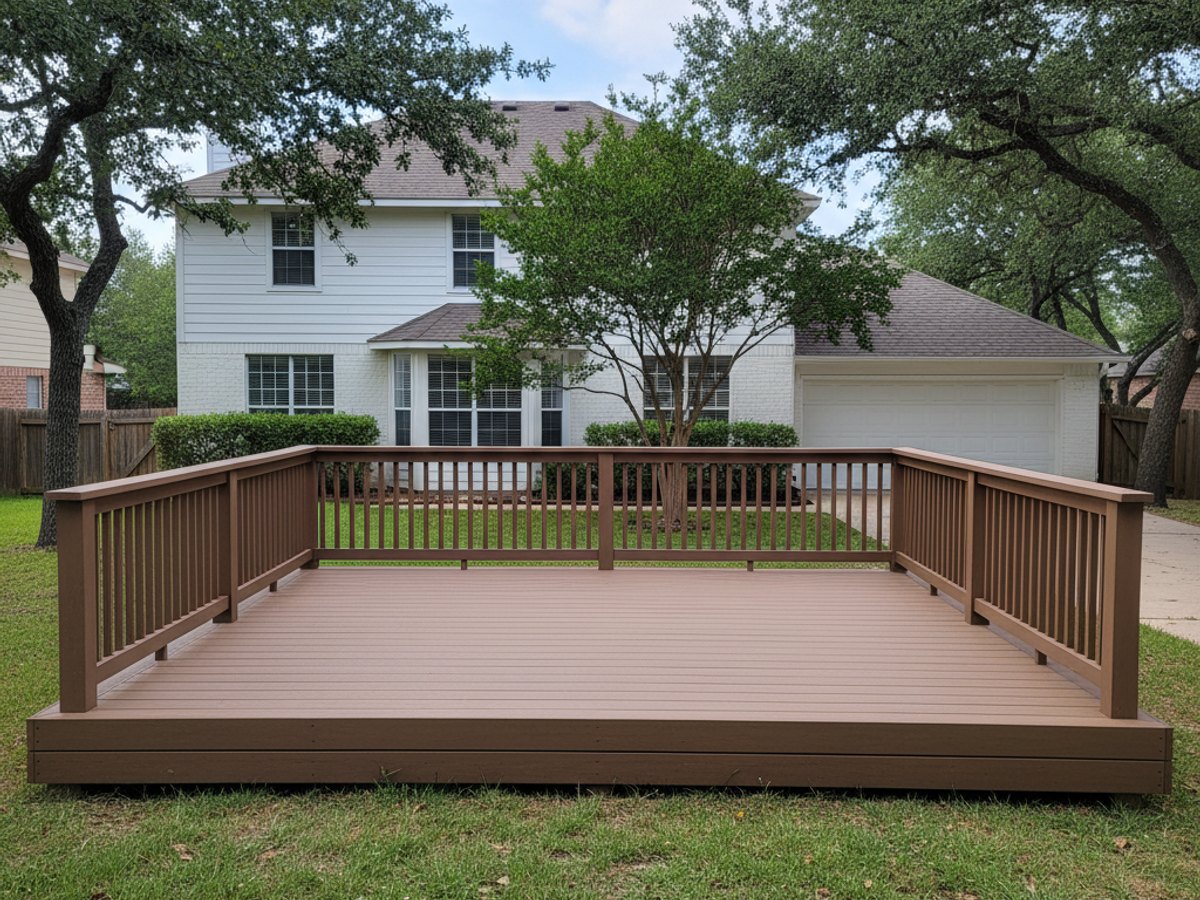
Mesquite sits on blackland prairie clay, the same stuff that runs under most of North Texas. That clay swells when it's wet and shrinks hard when it dries out, and a deck built on the wrong footings will tell you about it within a year or two. So before you talk price with anybody, talk about what's going in the ground.
A deck is only as good as what's under it. Anybody can screw boards to a frame. Not everybody sets a footing that survives a Texas clay soil for twenty years.
Ask what's holding the deck up
In this area, footings need to go below the active zone where the clay moves with moisture, usually 24 to 36 inches depending on the soil report and what the city requires. A lot of cheaper crews pour a shallow pad, 12 inches down, and call it good. That works fine for a year, maybe two, until a dry August and a wet October push the post in opposite directions and you've got a deck that rocks when you walk across it.
Ask what diameter the footings are and how deep they're going. Ask if they're using a bell-shaped bottom or a straight bore. A builder who knows this soil will have an answer without hesitating, because they've poured hundreds of them and watched what happens to the ones that were too shallow.
The ledger board is where decks actually fail
If the deck attaches to the house, the connection between the deck and the rim joist is the single most important detail on the whole project. This is where flashing goes, and it's where a lot of failures start, usually slow ones you don't notice until the ledger board is soft and the whole deck has pulled an inch away from the siding.
Ask if they're through-bolting the ledger with lag screws rated for the load, and ask if they're flashing above the ledger so water runs over it instead of behind it. A deck that leans on the house without proper flashing will let water sit against your rim joist every time it rains, and in a wet spring that's most weeks in April and May.
Permits aren't optional, and skipping them costs you later
The City of Mesquite requires a permit for most attached decks and for freestanding ones above a certain height, and it'll get inspected at least twice: once when the footings are dug and the forms or rebar are in, before any concrete goes in, and again at framing before the decking goes down. If a builder tells you permits are a waste of time or that they'll just build it and you won't have any trouble, that's the moment to stop the conversation.
Skipping the permit doesn't just risk a stop-work order. It shows up when you sell the house. Buyers' inspectors ask about permit history on any structure attached to the home, and an unpermitted deck can hold up closing or knock money off your price. A lot of the older neighborhoods around Mesquite, the ones built in the fifties through seventies off Galloway and Town East, already have decks that were added without permits decades ago. Don't add another one to the pile.
What the material choice actually changes
Pressure-treated pine is still the standard frame material here because it handles humidity and doesn't cost a fortune, but it needs to be rated for ground contact if any part touches soil or sits close to it. For the decking surface itself, you're choosing between wood that needs staining every two to three years in this heat, or composite that costs more up front and doesn't need that upkeep. Summer temperatures in the high 90s and low 100s through July and August will bake a poorly sealed wood deck fast, cracking and graying the boards within a season if it's not maintained.
Composite handles the heat better but it still needs proper joist spacing, usually 12 or 16 inches on center depending on the brand, tighter than what you'd get away with on solid wood. A builder who quotes the same joist spacing regardless of what decking you're putting down either isn't paying attention or is cutting corners to save lumber.
Red flags worth walking away from
- A quote with no mention of footing depth, post size, or fastener type. If it's just square footage times a dollar amount, you don't know what you're buying.
- No permit pulled and no mention of inspection. Ever.
- Asking for the full payment up front. A deposit is normal. The whole job paid before it starts is not.
- No proof of insurance. Ask for it directly, and call the insurer if you want to confirm it's active.
- Vague answers about lumber grade or fastener corrosion rating. Deck screws and joist hangers need to be rated for treated lumber, usually hot-dip galvanized or stainless, because the chemicals in modern treated wood eat through regular coated steel over a few years.
What a good conversation with a builder sounds like
You should walk away from the first meeting knowing the footing depth, the fastener type, whether they're pulling a permit, and roughly how many days you'll need to stay off the deck after the final coat if it's being stained on site (usually 24 to 48 hours, longer in humid weather). You should also know if they're subcontracting the concrete work or doing it themselves, because that changes who you call if a footing settles wrong.
None of this is complicated information. A builder who's done the work in Mesquite's clay and heat for years will give it to you without being asked twice. One who dodges the questions is telling you something too.
We build and repair decks all over Mesquite and the towns around it, footings, framing, and finish work included. If you want to see how we handle the details above on an actual job, take a look at Oasis Deck Co.